Often you’ll hear football fans discussing players that feel like they should have played for a certain club, despite the fact they never did. “Gareth Bale” always felt like a Manchester United winger, despite his move to the club never materialising. The same I believe can be true for managers: Mauricio Pochettino has always felt like a Manchester United manager.
Be it culturally, aesthetically, or stylistically, there are certain individuals that seem to echo a club’s ethos or soul, though they may never have had any concrete affiliation with said club. A Manchester United manager, in the same vein as Sir Matt Busby or Sir Alex Ferguson, is expected to instil an attacking, resilient style of football and incorporate hungry young players into their sides. Pochettino does these things.
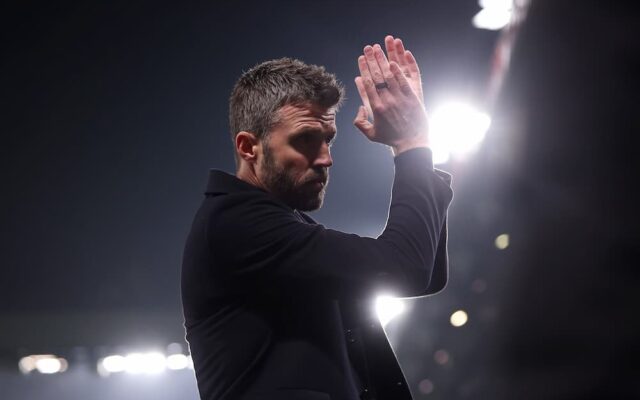
The Argentine has emerged as the leading candidate to replace Michael Carrick, who is expected to have managed his final game in charge against Aston Villa on Sunday. United’s key decision makers held talks following the dramatic 4-4 draw and are set to recommend a change in the dugout to Sir Jim Ratcliffe and the Glazers.

Pochettino ticks a lot of important boxes United will be judging potential candidates by as they search for the ideal Carrick replacement. He proved he can succeed with a limited budget during his years at Tottenham. His net spend at the North London club from 2014 to 2019 was around £50 million, while the average net spend of the other traditional ‘big six’ clubs across that period was £467 million. At Spurs he finished in the top four in four of his final seasons consecutively, as well as reaching a Champions League final.
Pochettino’s early coaching career and influences
After finding success in his first full-time management position in Spain as the boss of Espanyol, Pochettino joined Southampton in January 2013, arguably bringing the modern pressing approach to England in the most clearly identifiable form anyone had to that point. His Southampton side quickly became renowned for their impressive physical conditioning, aggressive pressing, attacking prowess, a high defensive line, and the integration of a number of younger players into the fold.
Pochettino’s coaching style is heavily influenced by Marcelo Bielsa, an early pioneer of high pressing football, combining elements of Dutch and Spanish philosophies and obsessing over pre-match preparation and the finer details. Bielsa first became a guiding figure in Pochettino’s life when he brought the young Argentine defender into his Newell’s Old Boys side aged 13.
That relationship has clearly stayed with him. Pochettino has often spoken about Bielsa with something approaching reverence, referring to him as his “football father”, and much of what we now associate with his own teams can be traced back to those early years. The aggressive man-marking, the high defensive line and the desire to win the ball back as quickly as possible are all familiar features of Bielsa’s football. There are other influences, like the Dutch emphasis on collective movement and the work of Arrigo Sacchi, whose AC Milan sides helped popularise the idea of pressing as a coordinated team effort rather than a series of individual actions.

His teams have never been a direct copy of Bielsa’s footballing ideologies, and instead have had their own characteristics. He has generally been quite adaptable to the players and resources available to him. At Tottenham he developed a side that could press aggressively but was also capable of playing through opponents, with the likes of Christian Eriksen, Dele Alli and Harry Kane giving the team a degree of technical quality that sometimes gets overlooked when discussing his football.
There are obvious reasons why this might appeal to United, namely that the club has spent much of the last decade trying to rediscover something of its former identity, and Pochettino’s approach feels considerably closer to the traditions of Sir Matt Busby and Sir Alex Ferguson than some of the more pragmatic football we’ve seen at Old Trafford. His teams are generally entertaining, play with intensity, and aren’t afraid to give young players responsibility. Those qualities have always been important at United, and the current squad has several players who could benefit from that kind of environment.
His record with young players is probably one of the strongest arguments in his favour when it comes to being a cultural fit with the traditions of Manchester United. Harry Kane was hardly an established star when Pochettino arrived at Tottenham, while Dele Alli, Son Heung-min and Eric Dier all developed significantly during his time there. At Southampton, too, he helped bring through Luke Shaw, James Ward-Prowse and others. There is a willingness to trust young players that feels particularly relevant at a club with United’s history and the resources of its academy.
Ex-players speak incredibly highly of Pochettino’s man-management skills, citing his unique emotional intelligence and character in their personal development under his guidance. In an increasingly tactical footballing landscape, man-management has become an underrated factor in platforming talent and maximising performance on the pitch. At the end of the day players are the best tactic available to a manager, and so knowing how best to empower them goes a long way in finding success on the field.
The Less Encouraging Indicators
It’s no secret that much of Pochettino’s positive reputation remains rooted in what he achieved at Tottenham, and that his career since hasn’t necessarily played out as one may have envisioned when he left the North London side.
Football has never been more tactically focused than it is today, with extreme emphasis placed on adaptability, positional rotations and the ability to find solutions against increasingly sophisticated opposition. Pochettino’s football can sometimes look a little one-dimensional when his sides aren’t able to impose their usual intensity. His preference for a high defensive line and aggressive pressing can leave plenty of space to exploit, particularly when the opposition are comfortable playing through the initial pressure. It’s something we’ve seen at various points throughout his career, and United’s current defensive vulnerabilities would make it a particularly important consideration.
At PSG, he inherited one of the most talented attacking trios in modern football in Messi, Neymar and Mbappé, but never really found a way to make them function as a convincing collective. There were obvious difficulties in managing such enormous personalities, and winning the French league in 2022 was hardly an insignificant achievement, but the football was often underwhelming. PSG looked reliant on individual brilliance, with relatively little of the collective intensity that had characterised Pochettino’s best sides.

It’s important to recognise that PSG had struggled until the arrival of Director of Football Luis Campos in 2022 to find a clear and effective recruitment strategy after years of almost exclusively signing big names on big wages. This made it difficult to really excel, and several other fantastic coaches, such as Thomas Tuchel and Unai Emery had come and gone, suffering from similar roadblocks. This lack of clear recruitment drive has been an issue at the core of United’s struggles since the departure of Sir Alex Ferguson, as the club have pursued players for their commercial strength, rather than their footballing ability or suitability to the club.
His stint as Chelsea boss came with other hurdlers as Pochettino inherited an extraordinarily young squad, with an enormous number of new signings and an ownership structure that was still finding its feet. Injuries were a constant problem, and it took much of his first season for the team to find any real consistency. There were signs of improvement towards the end, with Chelsea winning their final five league games and finishing sixth, but the relationship between Pochettino and the club’s hierarchy never seemed particularly comfortable.
The 54 year old has tended to do his best work when given time to build something, when the players buy into his methods and when there is a relatively clear direction at the club. Tottenham offered him that environment for several years, while PSG and Chelsea, for different reasons, didn’t. United’s own problems with recruitment, ownership and footballing structure mean that he could easily find himself facing similar frustrations at Old Trafford.
Reasons for Optimism
There have, however, been some encouraging signs from his time with the United States men’s national team. Appointed in September 2024, Pochettino took charge of a side with plenty of individual talent but one that had struggled to establish a consistent identity.
His approach has remained recognisably Pochettino. The intensity, physical demands and emphasis on collective responsibility are still there, but international football requires a slightly different approach to club management. Training time is limited, players arrive from different tactical environments and there is considerably less opportunity to drill the kind of detailed automatisms that he could work on every day at Tottenham. His willingness to adapt has therefore been encouraging, as has his ability to get players to buy into his demands over relatively short periods.
The 2026 World Cup has offered a useful indication of what that work can produce, as The United States topped their group, beating Paraguay and Australia, before defeating Bosnia and Herzegovina in the knockout stages. Their eventual elimination by Belgium in the last 16 was disappointing, but there was a noticeable improvement in the team’s organisation and attacking confidence. They looked a more coherent side than the one Pochettino inherited, and there were encouraging performances from some of their younger players.

It is perhaps not the sort of achievement that should be overstated, particularly given the advantage of playing on home soil, but it does suggest that Pochettino hasn’t lost the qualities that made him such an attractive appointment in the first place. He still seems capable of creating a strong collective spirit and getting players to work incredibly hard for one another. Those are things that United have lacked for over a decade.
A Natural Fit?
There is obviously no guarantee that Pochettino would be a success, but then again there is no such thing as a guarantee at Manchester United. His tactical side has some weaknesses, his recent club management record is mixed and the club’s decision making structure remains flawed to the point of almost entirely prohibiting any manager’s success.
His commitment to the US Men’s National Team is another stumbling block for a potential move to Old Trafford, with a release clause of up to £10 million potentially complicating United’s willingness to pull the trigger. Despite that, sources close to the Argentine suggest United is a club he has always been keen on managing, and would be happy to quit international management for if met with a formal approach.
United should be a club that excites people, develops its own talent and plays football with an unmistakable attacking ambition, and Pochettino has spent much of his career trying to build exactly those sorts of teams.
Perhaps there is a degree of romanticism involved in imagining him at Old Trafford. His career since Tottenham hasn’t been perfect, and there are certainly more fashionable tactical appointments available. But I can see the appeal of giving him a young squad, a clear direction and the opportunity to build something over several years.