For years, there has been an observable phenomenon afflicting new signings at Manchester United: players arrive with the energy and confidence of a fresh start, only to succumb to the rot around them after an initially promising run of games. Gradually, they become absorbed into the same shortcomings that have plagued the side for years.
There is already a subconscious expectation brewing that Carlos Baleba will follow a similar trajectory, although it is difficult to suggest that he has yet reached the heights that would make such a decline particularly noticeable. His performances have been encouraging in patches, with the physical attributes that made him such an attractive prospect at Brighton already apparent, but there remains a degree of rawness that still needs ironing out.
His arrival has offered United something that has been conspicuously absent from their midfield for a laughable amount of time. His ability to cover ground, compete physically and carry possession through the middle of the pitch adds a new dimension to the side, particularly in games where they might otherwise struggle to cope with the physical demands of the midfield battle.

The Cameroonian pulled up during the final few strides of a gallivanting solo run into Roma’s box, which initially looked like a real chance to threaten the Italian side’s goal, before being cut short by an evidently painful hamstring injury. The nature of Baleba’s grimacing after going down on Tuesday evening suggests something more serious than an innocuous tweak.
As such, the former Brighton man could be out of action for a sizeable chunk of the winter period, in what could be a major blow to Michael Carrick’s hopes of steering results back in a positive direction. United’s midfield is an area of reasonable depth following a summer window which saw three new midfielders arrive, although none of Baleba’s positional peers share his most valuable and distinctive traits.
It was particularly telling that Baleba’s replacement off the bench against Roma was Youri Tielemans, who arguably couldn’t bear less resemblance to his injured teammate in terms of profile and skillset. The stark contrast between Baleba’s attributes and those of the man who replaced him speaks to a lack of considered squad planning and recruitment ineptitude that has hardly been a secret at Old Trafford in recent years.
For all the positive traits that made United so keen on bringing Baleba to the club for £70 million in the summer, there is a degree of rawness that his first few performances have brought to light.
These areas of weakness were well documented ahead of his arrival, but United have a foreboding track record of failing to nurture young footballers and address their shortcomings. That raises some cause for concern about Baleba’s trajectory at the club. Players of his pedigree and promise have been signed before, only to find themselves in a coaching environment and club culture that fails to help them develop into the players their potential suggests they can become.
So just how much of a blow will his forthcoming absence be for Michael Carrick’s side heading into an incredibly hectic and crucial winter period?
A naivety out of possession
While Baleba’s physical capacity for ground coverage and rapid recovery runs is undeniably elite, his positioning can be naive at times. An aggressive approach to duels, while welcome in an otherwise tepid United midfield, occasionally leaves him overextended and compromises United’s rest defence in the event of central turnovers. Morgan Rogers’ first goal against Chelsea was a particularly consequential example of this.

The sequence starts with a turnover inside the halfway circle, as Mbeumo’s attempted turn is cut out by Romeo Lavia. Baleba, as proactive as ever, sees the ball run loose following Lavia’s tackle and decides to step up in an attempt to win it, seemingly unaware of the space behind him.

What Baleba doesn’t account for is that Lavia has already begun running towards the ball after dispossessing Mbeumo, and therefore has a head start. The Chelsea man gets there first and lays the ball off to Rogers, who suddenly has an abundance of space to run into.

Rogers is then able to drive through the vacated space ahead of United’s box, before splitting Martinez and Maguire and finishing neatly over Senne Lammens. While United’s defenders could, and should, have dealt with the situation better, the initial problem stems from the lack of protection in front of them. Baleba’s decision to step out leaves the central area exposed, allowing Chelsea to exploit the space before United can reorganise.
Baleba’s willingness to engage opponents and contest loose balls can make United considerably more difficult to play through, but there are occasions when that aggression comes at the expense of his positional responsibilities. His physical capacity to recover from those situations is a major asset, but a better understanding of when to commit high and how to position himself could ease the demands placed on his own ground coverage, as well as reducing the defensive vulnerability of his teammates.
Poor decisions on the ball
Against Como, Baleba demonstrated similar naivety, this time in possession. In the 56th minute, what should have been a simple pass away from Nico Paz’s pressure instead became a gift to the Argentine, who could hardly believe his luck as he made it three for his side.
A more mature player in Baleba’s position would have taken a touch or two away from Paz, creating the time and space to play back to his goalkeeper or find an available teammate nearby.
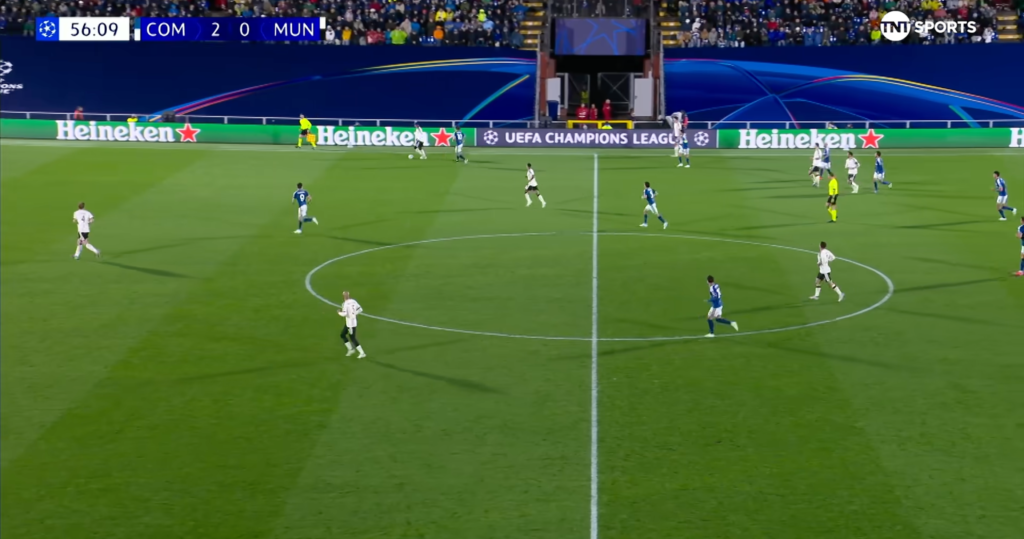
Admittedly, his teammates could have made a more concerted effort to offer themselves as passing options. Ultimately, however, the responsibility falls on the player in possession to evaluate the risks presented by the positions of both his teammates and the opposition, and make the correct decision accordingly.
Rather than minimising the risk, Baleba attempts to slip a deceptive ball into the path of Tielemans, but fails to bypass the outstretched leg of Nico Paz. The Argentine steals in and charges towards goal, leaving the Cameroonian trailing in his wake.

Despite Baleba’s pace allowing him to recover in the majority of situations like these, a player of Paz’s athleticism is capable of punishing such a mistake. Baleba’s attempted pass also leaves him facing the wrong direction to chase the Como attacker, who is already running towards United’s goal.
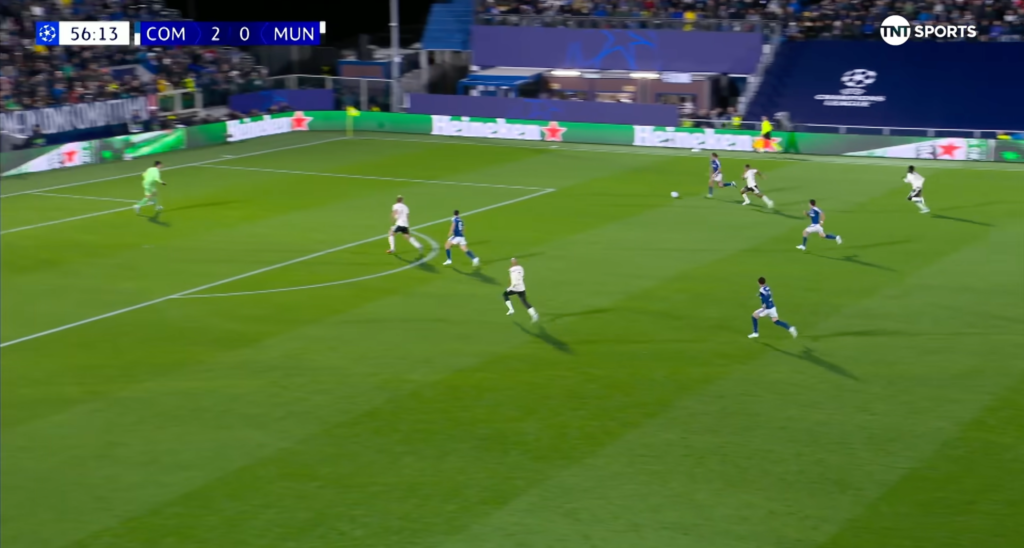
Paz makes no mistake when faced with Senne Lammens, putting his side three goals ahead and rendering the game out of reach for United. Against opponents of this quality, mistakes like that are liable to be punished without a second thought.
It was a disappointing lapse of judgement and concentration from Baleba, who had otherwise been United’s best player in an admittedly dismal team performance. It is a fairly accurate illustration of the compromise involved in starting him in midfield: the physical qualities he offers can be exceptional, but they do not yet come without a degree of risk.
Positive intent with and without the ball
There have also been moments of encouragement where Baleba’s ability to play forward has offered United a direct route into the final third. One sequence of give-and-goes against Leeds in October illustrated the progressive value he can offer when moving the ball through the centre of the pitch with speed and verticality.
In this passage, Baleba starts by receiving the ball behind the halfway line, with Yoro beside him. He threads a pass between two Leeds players to find Tielemans, who lays the ball off for Baleba to run onto.
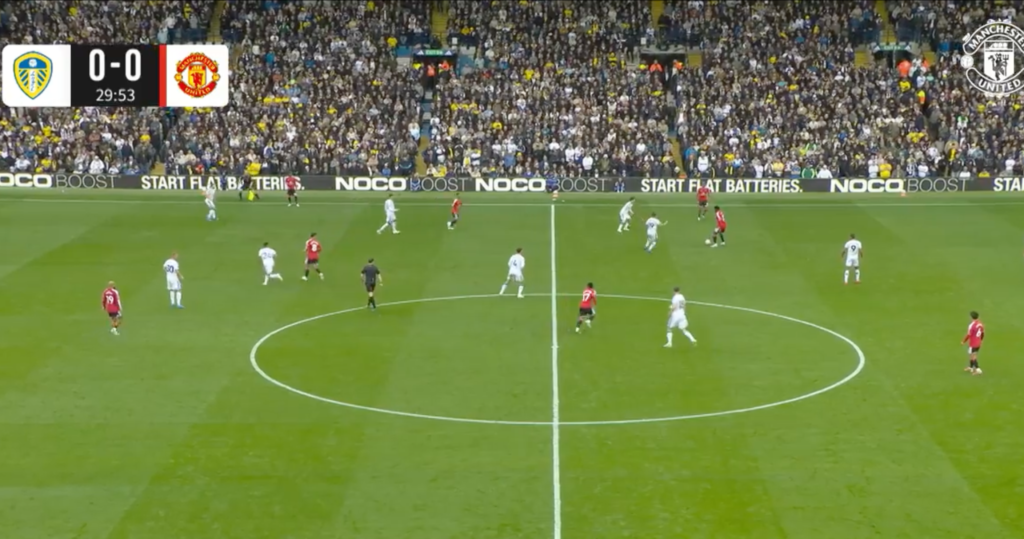
Crucially, Baleba has a fantastic habit of following his passes in anticipation of receiving the ball again and continuing an attacking move. He collects Tielemans’ lay-off and punches another ball forward with his first touch, this time into the path of Mbeumo, who drops off the last line to connect with his countryman.
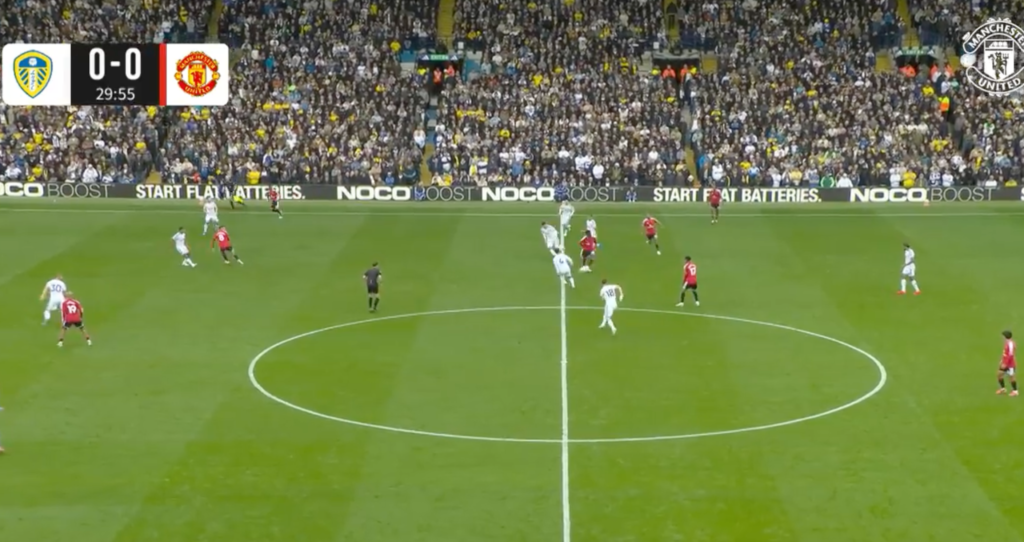
Once more, Baleba follows his pass, ready to receive the lay-off from Mbeumo, and again plays a first-time ball forward, this time out wide to Diogo Dalot on the left flank.
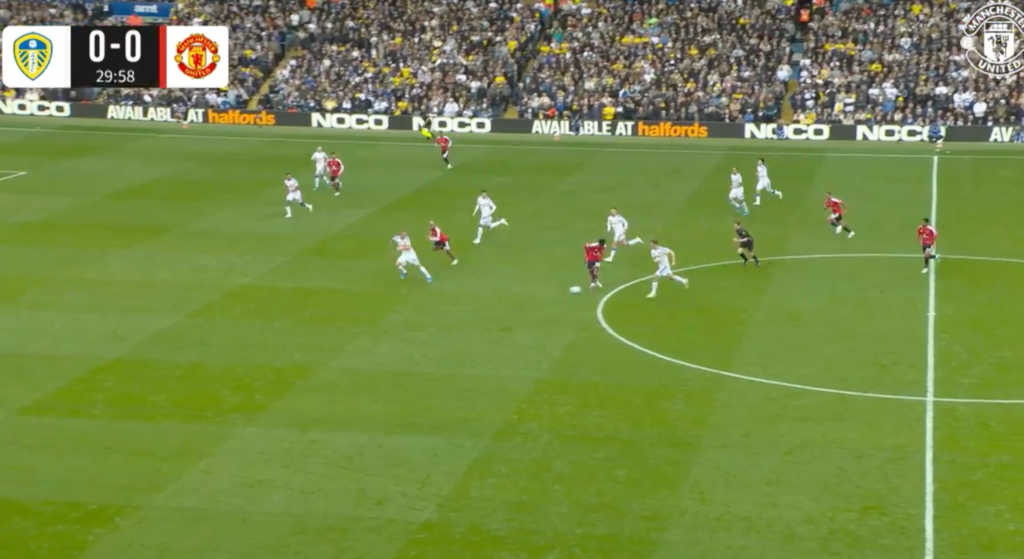
The pass is well weighted, allowing Dalot to maintain the momentum of his run all the way into Leeds’ box. Baleba’s running doesn’t stop there, as he sprints to the edge of the opposition box and makes himself available for the cut-back, which could have presented a shooting opportunity.

Dalot is ultimately unable to connect with a teammate, but the move has put United in a threatening position thanks to Baleba’s directness, athleticism and forward thinking. The sequence highlights the value he brings when playing with confidence and sharpness, and offers United a good indication of how best to platform his strengths.
United’s midfield rebuild is set to be put through its paces
Baleba’s injury and expected absence put the club’s summer business under the microscope, with decisions surrounding the three central midfielders recruited coming under scrutiny for varying reasons. A trio of deals for Santos, Tielemans, and Baleba saw United spend around £150 million on a midfield trio featuring none of their first-choice targets.
United also fell at the last hurdle in their efforts to sign Leicester City midfield starlet Louis Page in the summer window, despite a deal being close to completion. Unwilling to make up a difference of around five million pounds in valuation on deadline day, United decided to shelve the deal, with a view to potentially revisiting at a later date.

This failure to acquire someone who profiles so similarly to Baleba, for a reasonable fee, helps explain why his replacement off the bench against Roma was someone of a polar opposite disposition. A squad can accommodate different types of midfielder, and there is value in having players who offer contrasting qualities, but there still needs to be sufficient depth in the roles that a side cannot function effectively without.
Santos and Tielemans are both imperfect signings, and while technical quality and composure in possession are important they do not necessarily address the need for a player capable of covering large spaces, winning physical duels and protecting the defence when possession is lost. Both will be

United may be able to compensate through a change in shape or by asking other players to take on different responsibilities, but neither solution will replicate what Baleba brings naturally. The burden of covering ground and protecting transitions will have to be shared, and that may come at the expense of other aspects of the side’s play.

Baleba’s weaknesses remain an inevitable part of the player he is, but so too does the considerable physical presence he brings to a midfield that has often lacked it. His absence will leave Carrick with a difficult balance to strike, particularly during a demanding run of fixtures to come.